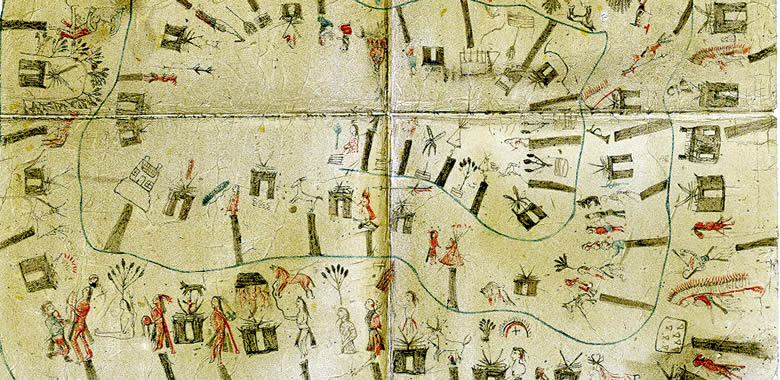
The Plains people did not have a written language of words and letters. They used pictures and symbols. Although they had a spoken language, when the early European explorers entered the plains area, they created a sign language. At one time, there were over 3000 different signs. Each had a meaning.
Pictures: The Plains people wrote on rocks, cave walls, and on scraps of buffalo hide. These pictographs told stories of their battles, heroes, and daily life. They also acted as warnings. There is a story about a Plains family who saw a picture sign by the side of a creek. This picture clearly told of an enemy camp just ahead. The family could tell that the writing was recent. There had been little wear to the message, and the weather had been wet. They quickly turned and took another route.
Smoke Signals: Smoke signals were another form of communication. The plains are flat. You could see a smoke signal for miles. By changing the puffs of smoke from short to long, they could send a message. Sometimes the message was one of warning. Some were simple messages like, "Come on home. It's time for supper!"
Fire Signals: Fire signals were used at night. These were motion signals made by running in front a fire, or running around it. Indian scouts could read these messages easily. One of the uses for fire signals was to tell other tribes of danger. Running around the fire meant "go away, get out of here."
Blanket Signals: Warriors used blankets to communicate to someone who could see them, but might not hear them. A wildly waving blanket told of danger. It gave the tribe a few precious extra minutes to get ready for an attack.
Mirror Signs: The Plains people did not invent the mirror. The white man brought the mirror with him. The Plains people put mirrors to good use. They traded for them with traders who might have thought the Plains people wanted to see themselves in a mirror. Not even close. They wanted mirrors to use to send signals in the daytime - signals that could be seen for miles - streaks of reflected sunlight, which could be read as easily as puffs of smoke. The mirror was instantly portable. They could send a signal on horseback, and be miles away in no time.
Sign Language: Not all the Plains people spoke the same language. To communicate with other tribes, they developed a sign language, a language of hand movements. Over time, the same signs were used all over the Plains area. Usually, each band had at least one sign talker. The "talkers" understood over 3000 different signs. Some of the "talkers" could sign faster than you could speak. When Europeans first started entering the Plains region, various tribes communicated with these early explorers using sign language.

